The forgotten story of the Festival Choral Society
Long before Waterford became famous for its International Festival of Light Opera, and decades before musical theatre became such a huge part of the city’s cultural life, Waterford was already making its voice heard across Ireland.
Quite literally.
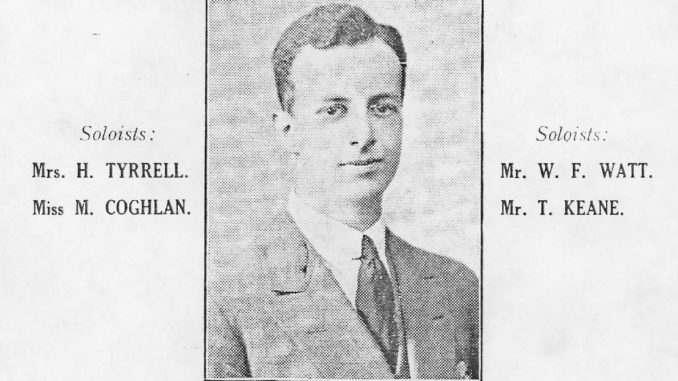
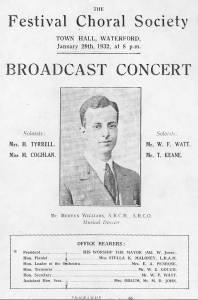
In the 1930s, the Waterford Festival Choral Society was one of the city’s leading musical organisations — and, remarkably, its performances were being broadcast on Irish radio. At a time when radio itself was still a relatively new phenomenon, hearing a choir from Waterford coming through the wireless into homes around the country must have been quite an event.
“A city of sincere musical activity”
One of the most fascinating references appears in the Dungarvan Observer in May 1936. An article headed “Why Not More Radio Programmes From the Deise?” complained that Waterford was not receiving enough recognition from the national broadcaster, despite the considerable musical talent in the city.
The article referred to a recent musical recital broadcast by the Festival Choral Society and quoted the Dublin Journal, which described Waterford as:
“a city of sincere musical activity.”
It is a wonderful description — and one which tells us that Waterford’s musical reputation extended well beyond the city itself.
The Festival Choral Society was mentioned alongside other local musical organisations and performers, including De La Salle College, the Waterford branch of the Gaelic League and the Barrack Street Brass Band.
The message was clear: Waterford had musicians, singers, choirs and performers capable of filling the airwaves.
So why weren’t there more broadcasts from the Deise?
Waterford’s voice on the wireless
It is easy today to underestimate just how significant a radio broadcast was in the 1930s.
Irish national broadcasting was still in its infancy. The first national station, 2RN, had only begun broadcasting in 1926.
For a Waterford musical society to appear on the national airwaves was therefore more than simply another concert.
It put Waterford’s musical life into sitting rooms and kitchens across the country.
And the Festival Choral Society was clearly considered capable of representing the city.
The 1936 newspaper account refers to its broadcast as a musical recital, suggesting that the society’s radio appearance may have consisted of a programme of choral and vocal works rather than one of the large-scale operatic productions that would become associated with the organisation in later years.
And that is where the story becomes particularly intriguing.
From choir to opera
The Festival Choral Society was not simply a choir.
Over the following decades it developed into one of the most ambitious musical organisations in Waterford, eventually presenting substantial operatic productions at the Theatre Royal.
By the 1950s, its repertoire included some of the great works of the operatic stage.
The Barber of Seville.
Il Trovatore.
Carmen.
Don Pasquale.
Martha.
Rigoletto.
These were not small-scale amateur productions. The society was working with choruses, orchestras and professional soloists and mounting productions on the Theatre Royal stage. By 1958 and 1959, the Festival Choral Society was producing major opera weeks, with performances supported by the Arts Council.
The scale of the operation is perhaps best illustrated by one small detail from 1959: demand for tickets was such that the society had booked the balcony of the Theatre Royal for its Opera Week.
Even the orchestra was being augmented, including the use of a Hammond electric organ.
The missing link in Waterford’s musical history
There is a fascinating story here which deserves to be better known.
We often think about Waterford’s musical-theatre history through the later International Festival of Light Opera, the city’s musical societies and the many amateur productions that have followed.
But the Festival Choral Society appears to be part of an earlier tradition.
A tradition that stretches from choral music and concert performance in the early twentieth century, through radio broadcasting in the 1930s, to full-scale opera in the Theatre Royal in the 1950s.
It shows that Waterford’s appetite for musical theatre and large-scale performance didn’t suddenly appear with the later festivals.
The foundations were already there.
Imagine the scene…
Imagine Waterford in 1936.
There are no smartphones. No television. No streaming services. No YouTube.
In homes around the city, people gather around the wireless.
And somewhere in Waterford, singers from the Festival Choral Society are preparing to perform.
Their voices are carried beyond the city, through the national broadcasting network and into homes elsewhere in Ireland.
For a city which sometimes felt overlooked by the national cultural establishment, it must have been quite a moment.
And perhaps that is why the words printed in the newspaper all those years ago are so memorable:
Waterford was “a city of sincere musical activity.”
Nearly ninety years later, they still ring true.
Be the first to comment